Indonesia EV Manufacturing Hub Attracts Global Automakers
The rise of the Indonesia EV manufacturing hub is reshaping the country’s industrial landscape. Global automakers are increasingly committing capital, technology, and production capacity to Southeast Asia’s largest economy, drawn by strong government incentives, vast mineral resources, and a rapidly expanding domestic market.
According to Indonesia’s Investment Ministry, seven electric vehicle manufacturers committed roughly IDR 15.4 trillion in investment between 2024 and early 2025, with projected production capacity reaching 281,000 vehicles annually. The companies include BYD, Aion, VinFast, Citroën, Maxus, Geely, and Volkswagen.
Beyond factory construction, the Indonesia EV manufacturing hub carries broader implications for national development. Policymakers view the sector as a vehicle for industrial upgrading, job creation, and the expansion of domestic supply chains that can sustain long-term economic growth.
Global Automakers Accelerate Indonesia’s EV Manufacturing Hub
Indonesia’s appeal lies in a combination of market size and industrial policy. With more than 280 million people and rising urbanization, the country offers a large consumer base for electric mobility.
At the same time, the government has implemented regulations that encourage automakers to move beyond imports toward domestic production. Incentives such as tax breaks and subsidies are increasingly tied to local manufacturing commitments, ensuring that international investment strengthens the local economy.
Chinese automaker BYD has become one of the most visible participants in this transition. After entering the Indonesian market in 2024, the company began developing a major production facility intended to serve both domestic and export markets in Southeast Asia.
Vietnamese EV manufacturer VinFast is also constructing a large factory in Subang, West Java, initially designed to produce about 50,000 vehicles per year. The project represents billions of dollars in potential long-term investment and reflects Indonesia’s growing importance in regional automotive supply chains.
Meanwhile, other global brands such as Aion, Geely, Citroën, and Maxus have signaled plans to expand their manufacturing footprint in the country as the Indonesia EV manufacturing hub gains momentum.
The Multiplier Effect Across Indonesia’s Economy
Job Creation and Industrial Skills
Large EV factories typically generate thousands of jobs directly while supporting many more positions across logistics, engineering, and services.
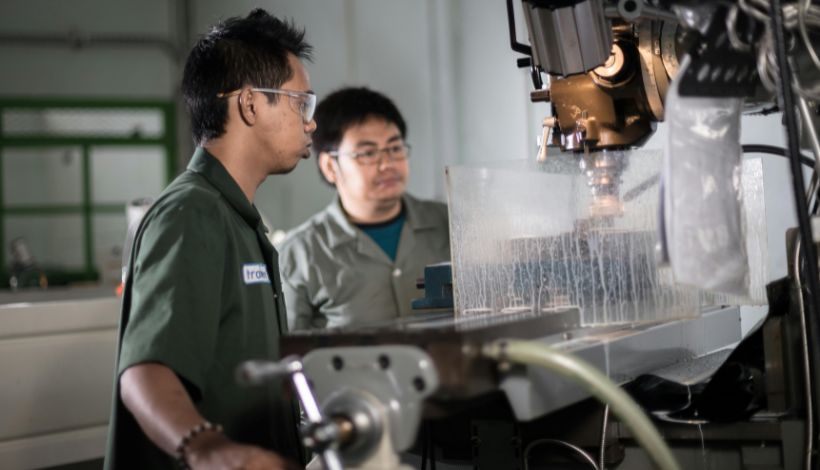
As international manufacturers establish operations in Indonesia, local workers gain exposure to advanced production technologies, automation systems, and electric drivetrain engineering. Over time, this knowledge transfer can elevate the country’s manufacturing capabilities and strengthen its workforce.
Industrial zones hosting EV plants also stimulate regional development. Infrastructure improvements, housing demand, and service industries often follow major factory investments.
Building Domestic Supply Chains
Another powerful multiplier emerges through supplier networks. Electric vehicles rely on components ranging from battery modules and semiconductors to power electronics and lightweight materials.
Indonesia’s local content requirements (TKDN) encourage manufacturers to source components domestically whenever possible. The policy provides opportunities for Indonesian companies to enter the EV ecosystem as parts suppliers, engineering partners, or technology developers.
Small and medium-sized enterprises can benefit significantly from this shift. As the Indonesia EV manufacturing hub expands, hundreds of supporting businesses from metal fabrication firms to software providers may find new opportunities in the automotive value chain.
Linking Mineral Wealth to Industrial Production
Indonesia holds some of the world’s largest nickel reserves, a key material used in lithium-ion batteries. For decades, the country exported raw minerals with limited value-added processing.
The government’s downstream strategy aims to change that equation by encouraging investment in nickel refining, battery manufacturing, and electric vehicle assembly within Indonesia.
Several battery projects are already under development. One large lithium battery plant developed with Chinese partners is expected to begin operations before the end of the decade. When integrated with EV factories, these facilities could create a fully connected supply chain from mineral extraction to finished vehicles.
Such integration strengthens the economic impact of the Indonesia EV manufacturing hub, allowing the country to capture greater value from its natural resources.
Rapid Growth in Domestic EV Adoption
Investment in manufacturing coincides with rising demand for electric vehicles across Indonesia.
Government incentives for EV buyers, including tax reductions and subsidies, have helped accelerate adoption. Charging infrastructure has also expanded steadily in major cities such as Jakarta, Surabaya, and Bandung.
Sales data shows strong growth in electric vehicle purchases in recent years, with several international brands gaining traction among Indonesian consumers. Analysts expect the domestic EV market to expand rapidly throughout the decade as prices decline and infrastructure improves.
Strategic Implications for Southeast Asia
Indonesia’s EV ambitions extend beyond its domestic market. By developing large production capacity and integrated battery supply chains, the country aims to become a regional export center for electric vehicles.
Southeast Asia remains one of the fastest-growing automotive markets globally, and many neighboring countries have yet to build extensive EV manufacturing capabilities. Indonesian factories could supply vehicles to these markets while supporting regional electrification.
For global manufacturers, locating production in Indonesia offers access to both raw materials and a vast regional market.
Conclusion
The emergence of the Indonesia EV manufacturing hub reflects a strategic effort to transform the nation’s economic structure. International automakers are bringing investment and technology, while government policy ensures that the benefits extend beyond vehicle sales.
Factories, supplier networks, and battery production facilities are beginning to form an integrated ecosystem capable of supporting long-term industrial development. For Indonesia, the electric vehicle sector represents more than a shift in transportation. It signals the rise of a new manufacturing chapter one that connects natural resources, advanced technology, and global investment to create enduring opportunities for the country and its people.