ASEAN Data Centres: Indonesia’s New Digital Map

For years, Southeast Asia’s data-centre story could largely be told through Singapore. Today, that geography is changing.
The rapid adoption of artificial intelligence, cloud computing and high-performance computing is creating a new infrastructure equation. ASEAN data centres are increasingly being shaped by electricity availability, land, fibre connectivity, water, cooling capacity and speed of deployment alongside conventional considerations such as market demand.
Singapore remains the region’s established digital gateway, while Malaysia, Thailand, the Philippines and Vietnam are expanding their own capacity. At the same time, Indonesia particularly Batam is gaining strategic relevance as companies look beyond the region’s most mature hub.
The result is a new digital geography: a multi-hub ASEAN ecosystem in which compute, power, connectivity and industrial infrastructure increasingly develop together.
AI Is Rewriting the Data-Centre Equation

The fundamental change begins inside the data centre itself. Traditional enterprise and cloud workloads already required substantial computing and storage capacity. AI introduces a different intensity. Training and deploying advanced models rely heavily on accelerated computing, including GPUs, which can generate significantly higher power densities than conventional server environments.
The International Energy Agency estimates that data centres consumed about 415 terawatt-hours of electricity globally in 2024, equivalent to around 1.5% of global electricity consumption. Under its base case, that figure could more than double to approximately 945 TWh by 2030. Electricity consumption from accelerated servers, driven largely by AI, is projected to grow by around 30% annually.
That changes the investment equation. A future-ready data centre requires more than racks and buildings. It requires access to reliable electricity, increasingly sophisticated cooling systems, resilient networks and infrastructure capable of supporting high-density computing.
The five forces reshaping ASEAN data centres therefore converge around one principle: digital infrastructure is becoming an energy-and-connectivity problem as much as a technology problem.
Five Forces Changing the Market
AI is changing load profiles. GPU-intensive workloads require higher power density and more sophisticated cooling.
Capacity is decentralising. Singapore’s constraints have encouraged investment to move into neighbouring markets, particularly Johor and Batam.
Power is becoming a site-selection variable. A location with land but insufficient grid capacity cannot support hyperscale ambitions.
Connectivity is becoming strategic. Subsea cables and low-latency fibre routes increasingly determine whether a facility can function as part of a regional digital ecosystem.
ASEAN is becoming an integrated infrastructure market. Cloud platforms, AI compute, fibre, energy, semiconductors, industrial estates and digital services increasingly interact as one investment system.
The IEA expects Southeast Asia’s electricity demand from data centres to more than double by 2030, reflecting the region’s expanding role in the global digital economy.
ASEAN Data Centres Are Becoming a Multi-Hub Market
The most important geographical development is the emergence of several interconnected centres rather than a single dominant location.
Current market estimates illustrate the scale of the transition, although the numbers should be treated as indicative rather than directly comparable because research providers use different definitions for operational, committed, under-construction and planned capacity.
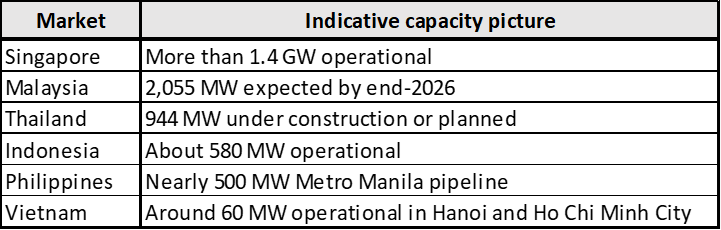
Singapore remains ASEAN’s largest established data-centre market, with more than 1.4 GW of operational capacity. Yet its physical constraints have encouraged development beyond the island. The ASEAN Guide for Sustainable Data Centre Development identifies Johor and Batam as important beneficiaries of that spillover.
Malaysia, meanwhile, is moving at extraordinary speed. JLL estimates national capacity could reach 2,055 MW by the end of 2026, with another 3,500 MW in the pipeline beyond that period. Johor’s proximity to Singapore has been central to its expansion.
Thailand presents another rapidly expanding market. BMI reported 944 MW of capacity under construction or in the planning pipeline in Q2 2026, compared with 216 MW of live capacity. Bangkok remains dominant, while the Eastern Economic Corridor, particularly Chonburi, is developing as a secondary centre.
The Philippines has a pipeline approaching 500 MW in Metro Manila, while Vietnam’s Hanoi and Ho Chi Minh City together had around 60 MW of operational capacity according to JLL data reported in March 2026.
The emerging picture is therefore more nuanced than a simple race for the largest capacity. ASEAN is developing a network of specialised hubs, each responding to different combinations of land, power, connectivity, regulation, customers and infrastructure.
From Data Centres to AI Infrastructure
This is where the market story becomes more strategic. The conventional data-centre model could begin with a simple proposition: secure land, build a facility, connect electricity and lease capacity.
AI infrastructure demands a broader sequence:
Digital demand → AI workloads → high-density infrastructure → power and cooling → network fabric
As workloads become denser, electricity becomes increasingly central to site selection. Cooling also becomes more sophisticated because higher rack densities generate greater thermal loads.
The IEA estimates that servers account for roughly 60% of electricity demand in modern data centres, while cooling can range from around 7% in highly efficient hyperscale facilities to more than 30% in less-efficient enterprise facilities.
Consequently, the emerging investment proposition can be expressed through five interconnected requirements: Compute + Power + Connectivity + Sustainability + Speed-to-Market
Compute determines what workloads a facility can support. Power determines whether those workloads can operate at scale. Connectivity determines how efficiently the facility interacts with customers, cloud platforms and other digital hubs.
Sustainability increasingly influences both corporate procurement and infrastructure planning. Speed-to-market determines how quickly capital can become productive capacity in a market where AI demand is moving faster than traditional infrastructure cycles.
This explains why ASEAN data centres increasingly intersect with energy policy, industrial estates, subsea cable development and national digital strategies.
Why Indonesia Matters on the New Digital Map
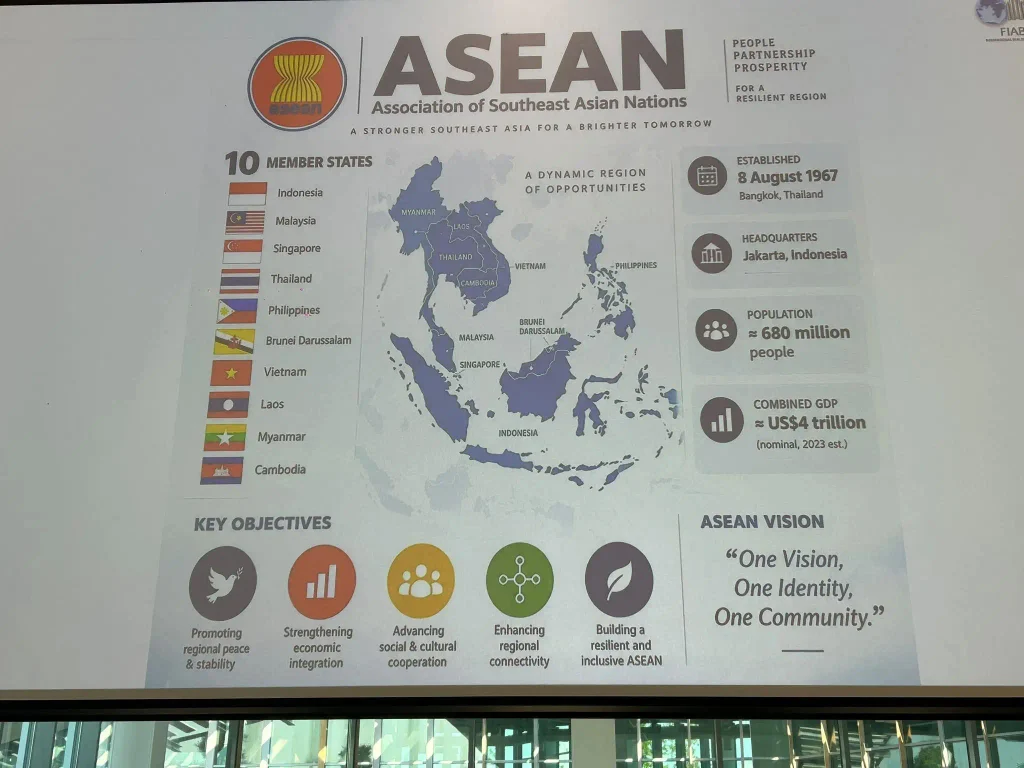
Indonesia enters this transformation with a combination that few regional markets can replicate: a large domestic economy, substantial land availability, growing digital demand and multiple potential locations for large-scale infrastructure.
National operational data-centre capacity stood at approximately 580 MW in the first half of 2026, according to Indonesian government statements reported by ANTARA. Coordinating Minister for Economic Affairs Airlangga Hartarto said investors had expressed interest in an additional 1.3 GW, with potential investment estimated at US$15 billion to US$20 billion.
Research from Brights also puts Indonesia’s installed IT capacity at approximately 580 MW and projects the national market could reach 3.5 GW by 2030. Its research identifies Jakarta as the largest existing centre while highlighting Batam’s substantial development pipeline. Yet Indonesia’s relevance extends beyond Jakarta.
Batam: Where Geography Becomes Infrastructure Strategy
Batam sits across the water from Singapore, placing it inside the wider Singapore–Johor–Riau digital corridor. Its appeal comes from the combination of proximity, industrial infrastructure, available land and connectivity. DC Byte identifies Batam as a spillover market that emerged during Singapore’s earlier restrictions on new data-centre development, with operators attracted by its proximity to Singapore, subsea connectivity, land and power availability.
The development of submarine cables is reinforcing that position. In July 2026, Singapore and Indonesia marked the completion of the Nongsa–Changi submarine cable, a direct link between Changi and Nongsa Digital Park. The system is designed to strengthen connectivity between the two markets as Batam develops its digital infrastructure base.
Another major system, the INSICA cable, is expected to support connectivity between Singapore and Batam, with Telkom subsidiary Telin and Singtel identifying AI workloads and higher power-density requirements among the drivers for stronger interconnection. The significance extends beyond a faster cable.
Batam can increasingly function as an extension of Singapore’s digital ecosystem while offering Indonesia’s land, industrial and infrastructure advantages. BW Digital, for example, has planned the 144 MW NDP-1 data centre in Batam as an AI-oriented facility with liquid cooling and direct access to the company’s subsea network.
That combination gives Batam a distinctive position within ASEAN data centres: close enough to Singapore to participate in its digital ecosystem, yet geographically situated within Indonesia.
Asia’s Data-Centre Map Is Expanding Beyond ASEAN
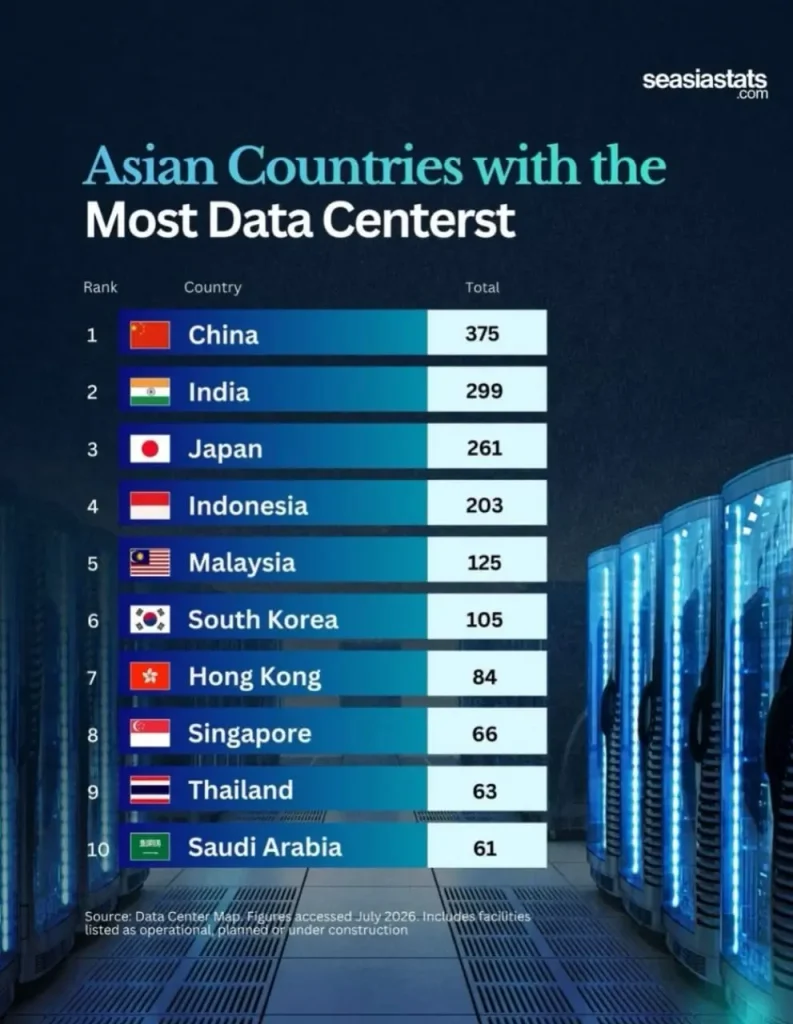
Across Asia, the data-centre market is developing into a network of specialised hubs rather than a single regional centre. Each market brings a different combination of domestic demand, international connectivity, energy availability, land, technology capability, capital and strategic geography.
Singapore remains one of Asia’s most established digital gateways, combining global connectivity, cloud infrastructure, financial-market depth and proximity to Southeast Asia’s rapidly expanding markets. Its land and power constraints, however, have also encouraged capacity to develop across neighbouring markets such as Johor and Batam.
Malaysia, particularly Johor, has emerged as one of the region’s fastest-growing data-centre locations. Its proximity to Singapore, availability of land and expanding power infrastructure have positioned Johor as a natural extension of the Singapore digital ecosystem.
Indonesia brings a different proposition: a vast domestic market, growing digital consumption, extensive industrial zones and multiple potential development locations. Batam, in particular, sits within a strategically important Singapore-connected corridor, while Jakarta and other industrial regions provide access to Indonesia’s domestic demand.
Thailand is building its own hyperscale proposition around Bangkok and the Eastern Economic Corridor, supported by industrial infrastructure and growing digital demand. Its location also gives operators access to the broader mainland Southeast Asian market.
Vietnam offers another growth pathway, supported by its expanding digital economy, manufacturing base and technology sector. Hanoi and Ho Chi Minh City remain the principal centres, while future development will depend increasingly on power, connectivity and regulatory capacity.
The Philippines combines a large English-speaking digital workforce with strong domestic demand and expanding cloud and data-centre requirements. Metro Manila remains the primary market, while additional locations could become increasingly relevant as infrastructure expands.
Beyond Southeast Asia, the competitive landscape becomes even more significant.
India represents one of Asia’s largest long-term data-centre opportunities because of its enormous digital economy, rapidly expanding cloud adoption, AI ambitions and massive population. Mumbai, Chennai, Hyderabad, Delhi-NCR and Bengaluru are developing as major digital infrastructure centres, giving India both domestic scale and a growing role in global technology infrastructure.
Japan brings technological maturity, sophisticated infrastructure, strong enterprise demand and extensive connectivity. Tokyo and Osaka remain major data-centre markets, while Japan’s emphasis on resilience and advanced technology gives it a distinct position in the regional ecosystem.
South Korea combines one of the world’s most advanced digital economies with exceptional broadband infrastructure, semiconductor capabilities and strong technology companies. Seoul and surrounding regions remain central to the country’s data-centre development, although power availability and permitting have become increasingly important considerations.
Hong Kong continues to serve as a critical gateway between international capital and Greater China. Its dense financial ecosystem, connectivity and proximity to major Asian markets support its role as a high-value digital infrastructure location, even as land and power constraints shape the development model.
Saudi Arabia represents a different kind of emerging digital infrastructure story. Driven by Vision 2030, AI ambitions, cloud adoption and large-scale technology investment, the Kingdom is positioning itself as a digital and computing hub connecting the Middle East with Asia, Europe and Africa. Riyadh in particular is becoming an increasingly important location for hyperscale and AI infrastructure.
Taken together, these markets reveal a much broader transformation. India offers scale; Japan offers technological maturity; South Korea brings advanced digital and semiconductor capabilities; Hong Kong provides financial and regional connectivity; Singapore functions as a global gateway; Saudi Arabia is building a new AI and digital-infrastructure hub; Malaysia offers rapid hyperscale expansion; while Indonesia combines domestic scale, land and strategic ASEAN connectivity.
The implication is important for investors and technology companies: there is no single formula for selecting an Asian data-centre location. The relevant question increasingly becomes which combination of compute, power, connectivity, land, customers, sustainability, regulation and speed-to-market best matches the intended workload.
That makes Asia’s emerging data-centre geography less a competition between countries than an increasingly interconnected infrastructure ecosystem with Indonesia becoming an increasingly important part of that map.
The New Geography of Digital Capital
The next phase of ASEAN data centres will increasingly be shaped by infrastructure integration. A data-centre campus needs electricity. AI workloads require higher-density computing. Higher density requires advanced cooling. Regional applications require resilient fibre. International traffic requires submarine cables. Large campuses need water, industrial services and skilled people.
Each element reinforces the others. That is why the rise of Indonesia should be understood within the wider ASEAN transformation rather than as an isolated national data-centre story.
For investors, operators and technology companies, the first question is consequently becoming geographic and strategic: Where does Indonesia sit within the emerging architecture of Southeast Asia’s digital economy? The answer begins with Batam, but it does not end there.
Understanding the Map Before Entering the Market
The next generation of ASEAN data centres will be defined by more than server capacity. It will be shaped by the intersection of AI, energy, connectivity, industrial land, sustainability and execution speed.
Singapore remains a crucial regional node. Johor is expanding rapidly. Thailand is developing a major hyperscale pipeline. The Philippines and Vietnam are building their positions. Indonesia is emerging with its own combination of domestic demand, infrastructure potential and strategic geography.
For Indonesia, Batam offers perhaps the clearest expression of this shift: an Indonesian location increasingly integrated into a Singapore-connected digital corridor.
RL
Related articles:
FIABCI Taichung: A New Urban Future Begins in Taiwan
Central Mid-Levels Escalator: Hong Kong in Motion
Belt and Road Summit Hong Kong 2026: Indonesia’s Next Investment Deals