REI Drives ASEAN Data Centre Investment Push Across Asia-Pacific
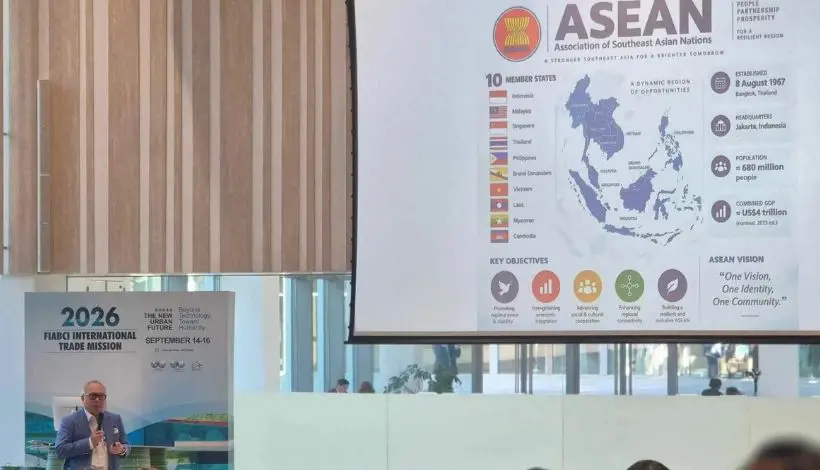
A quiet contest for digital supremacy is unfolding across Southeast Asia, and ASEAN data centre investment now sits at its very heart. As artificial intelligence reshapes industries from banking to manufacturing, computing power has become as essential as electricity itself, turning data centres into the physical backbone of the AI economy. REI (Real Estate Indonesia), the country’s national association of property developers, is stepping forward to claim a leading role in that transformation, carrying its pitch across three continents in a single, deliberate September.
A Region Reawakens: The Case for ASEAN Data Centre Investment
Between 9 and 18 September 2026, Rusmin Lawin, Vice President for Foreign Affairs of REI, delivered a consistent message across three cities: Hong Kong, Taichung, and Manila. At the Belt and Road Summit 2026 in Hong Kong, the FIABCI International Trade Mission 2026 in Taichung, Taiwan, and the 4th PFRESPI Summit 2026, hosted by the Philippines Federation of Real Estate Service Professionals Inc. (PFRESPI), Lawin represented REI in arguing that data centre investment across ASEAN has moved well beyond a niche real estate play. It has become, in his framing, a strategic imperative for the entire bloc, and one REI intends to help Indonesia capture.
His timing was deliberate. Global enterprises are racing to secure computing capacity for AI workloads, and Southeast Asia, long viewed as a manufacturing and consumer market, is now competing directly with established hubs in Japan, South Korea and Australia for that capital. REI’s decision to press this case simultaneously in Hong Kong, Taiwan and the Philippines signals how seriously Indonesia’s developer community now treats digital infrastructure as core business, not a peripheral interest.
Five Fundamentals Behind REI’s Pitch

Lawin’s argument, delivered on behalf of REI, rested on five structural pillars, each grounded in measurable scale rather than aspiration:
- Economic weight. ASEAN’s combined GDP ranges between $3.8 trillion and $4 trillion, ranking fifth globally behind only the United States, China, Japan and Germany.
- Population depth. The bloc is home to roughly 680 to 700 million people, a consumer and labour base larger than either the European Union or the United States.
- Regional standing. ASEAN ranks as Asia’s third-largest economy and functions as a central node in global supply chains.
- Trajectory. Forecasts place ASEAN as the world’s fourth-largest economy by 2030, overtaking several G7 members.
- Physical readiness. Power generation and water availability, the two resources most critical to hyperscale data centre operations, remain sufficient across key ASEAN markets.
Taken together, these five factors form the economic rationale REI used to argue that ASEAN data centre investment, and Indonesia’s share of it in particular, deserves a materially larger slice of global capital flows.
REI’s Bid to Position Indonesia at the Centre of ASEAN Data Centre Investment
Lawin’s credentials extend beyond his role at REI. He also serves as President of FIABCI Asia-Pacific Region for the 2022–2026 term, giving REI a platform that spans Hong Kong’s financial circuits, Taiwan’s industrial networks and the Philippines’ property sector simultaneously. That reach matters, because attracting data centre investment increasingly depends less on any single government’s incentives and more on cross-border investor confidence, precisely the kind of confidence REI has spent this campaign building.
“ASEAN is evolving from a conventional data-centre market into a regional digital infrastructure corridor driven by cloud, AI, connectivity, energy and sovereign digital requirements,” Lawin said, speaking in his capacity as REI’s Vice President for Foreign Affairs. He added a pointed caveat for developers chasing this opportunity: “The next phase of growth will not be determined simply by availability of land and buildings, but by the ability to combine reliable power, high-capacity connectivity, AI-ready infrastructure, sustainability and speed-to-market.”
Three Stages, One Consistent Message from REI

The choice of venues was not incidental, and neither was the sequence. REI’s ten-day itinerary moved deliberately from one node of regional capital to the next.
Hong Kong, 9-10 September 2026: Belt and Road Summit 2026. REI opened its campaign here, giving Lawin access to Belt and Road-linked capital and the state-backed investment networks that flow through the summit.
Taichung, Taiwan, 14-16 September 2026: FIABCI International Trade Mission 2026. REI’s second stop connected the association with FIABCI’s global trade network, a natural fit given Lawin’s parallel role as President of FIABCI Asia-Pacific Region.
Manila, the Philippines, 18 September 2026: The 4th PFRESPI Summit 2026. REI closed its circuit here, hosted by the Philippines Federation of Real Estate Service Professionals Inc. (PFRESPI), placing the association directly among Philippine real estate professionals weighing their own market’s digital ambitions.
Running the same argument through three distinct audiences, in three different regulatory environments, over the span of ten days, reflects a coordinated campaign by REI rather than a series of isolated appearances.
Mapping the Region’s Data Centre Investment Landscape
Numbers tell the story that rhetoric alone cannot, and they explain why REI has chosen this moment to press Indonesia’s case so publicly. Singapore remains the region’s established anchor, with more than 1.4 gigawatts (GW) of operational capacity already online, a legacy of its early positioning as Southeast Asia’s financial and connectivity hub. Malaysia, however, is closing the gap fast: the country is projected to reach approximately 2,055 megawatts (MW) by the end of 2026, a scale of expansion that reflects aggressive land release and power allocation by Malaysian authorities, particularly in Johor.
Thailand follows with roughly 944 MW across live and pipeline projects, while Indonesia currently counts around 580 MW of installed capacity a figure REI’s campaign is explicitly designed to grow. The Philippines holds approximately 500 MW in its Metro Manila pipeline, and Vietnam, still in earlier stages of build-out, accounts for around 60 MW.
Singapore’s Head Start, Malaysia’s Sprint, and Where REI Sees Opportunity for Indonesia
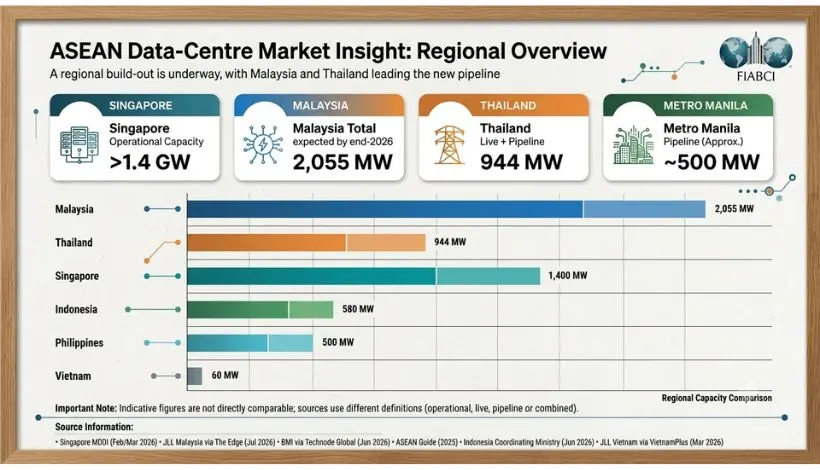
This spread illustrates an uneven but genuinely multi-hub region rather than a single dominant centre. Singapore’s moratorium-driven land constraints pushed overflow demand toward Johor Bahru years ago, and Malaysia’s resulting momentum now threatens to overtake the city-state in raw megawatts, even as Singapore retains its edge in connectivity density and financial services integration. It is against this backdrop that REI sees Indonesia’s 580 MW base not as a weakness but as room to run, provided the right power and connectivity commitments follow.
Why ASEAN Data Centre Investment Is Accelerating Now
The underlying driver is straightforward: artificial intelligence workloads consume dramatically more power and cooling capacity than traditional cloud storage, and enterprises need that capacity physically close to their customer bases across Asia. ASEAN data centre investment therefore benefits doubly, from both the bloc’s existing digital economy and the new wave of AI-specific demand that traditional hubs in Northeast Asia and Australia cannot absorb alone. REI’s outreach is essentially a bet that Indonesia can claim a larger share of that doubled demand if it moves now.
Power, Water and Speed-to-Market
Lawin’s closing argument, offered on REI’s behalf, that success will hinge on power reliability, connectivity, sustainability and execution speed rather than land availability alone, echoes what site-selection consultants across the industry have been telling hyperscale operators for several years. Countries that pair available land with firm power purchase agreements and fast permitting will capture disproportionate shares of new capital, while those relying on land availability alone risk being bypassed, a warning REI appears determined to make sure Indonesia heeds.
The Race for Megawatts Is Just Beginning

What emerges from REI’s three-city campaign is less a single announcement and more a signal that ASEAN’s data centre story has entered a more competitive, more sophisticated phase. Through Lawin, REI is making a deliberate case for Indonesia’s 580 MW base to grow substantially, while Malaysia’s sprint toward 2,055 MW shows how quickly the regional hierarchy can shift. With a combined GDP nearing $4 trillion, a population approaching 700 million, and a trajectory toward becoming the world’s fourth-largest economy by 2030, ASEAN’s underlying fundamentals give real weight to REI’s pitch. The bloc’s various markets, from Singapore’s mature ecosystem to Vietnam’s early-stage buildout, now compete and complement one another simultaneously, and the next several years will determine whether REI’s campaign succeeds in converting Indonesia’s structural advantages into actual gigawatts on the ground.
GM
Related articles:
PropTech AI Turns a Single Building’s Data into Portfolio-Wide Intelligence
PropTech AI Is Quietly Rewriting the Economics of Every Building in Asia
Entering Indonesia: Preparing for the Next Investment Wave
ASEAN Real Estate Resilience: From Crisis to Growth
ASEAN Investment: Why Indonesia Stands at the Center of Southeast Asia’s Next Growth Cycle
ASEAN Data Centres: Indonesia’s New Digital Map
FIABCI Taichung: A New Urban Future Begins in Taiwan
Belt and Road Summit Hong Kong 2026: Indonesia’s Next Investment Deals