AI Smart City Asia Pacific: How Nusantara Is Redefining Urban Development
Global Context
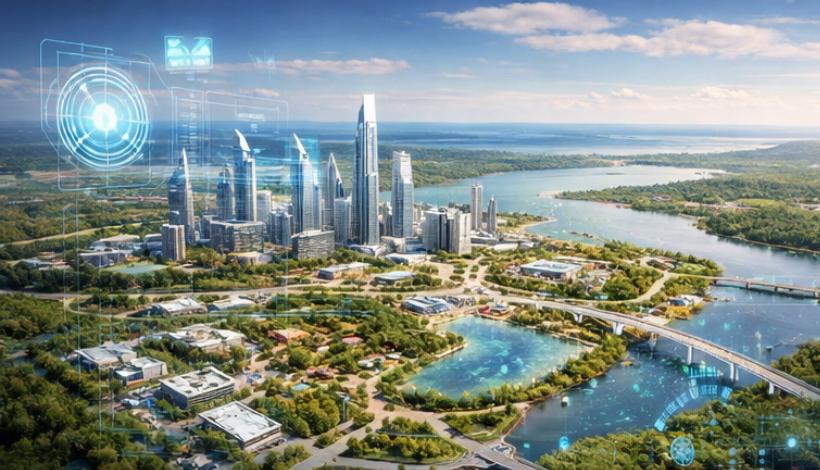
Across Asia Pacific, governments are rethinking how cities function in an era shaped by digital acceleration, climate urgency, and economic competition. Indonesia’s new capital, Nusantara, introduces a different starting point one where artificial intelligence and smart systems are embedded from the earliest stages of planning. Located in East Kalimantan, the city reflects a deliberate shift toward data-driven governance and sustainable infrastructure. As global cities struggle to modernize legacy systems, Nusantara positions itself as a working model of AI Smart City Asia Pacific, offering insights into how future urban environments may be designed, managed, and scaled.
The Strategic Rise of AI Smart City Asia Pacific
Urban expansion across Asia Pacific continues to accelerate. The region leads global urban population growth, placing pressure on transportation, energy systems, and public services. In response, governments increasingly integrate artificial intelligence into city planning to improve efficiency and resilience.
Within this broader shift, Nusantara emerges as a national flagship project. Indonesia’s capital relocation strategy reflects both environmental concerns such as Jakarta’s congestion and flooding risks and economic ambitions to distribute growth beyond Java.
Academic research confirms that Nusantara has been designed explicitly as a smart city, integrating digital infrastructure, governance systems, and sustainability principles from the outset.
This alignment of policy, infrastructure, and technology strengthens its role within the evolving AI Smart City Asia Pacific landscape.
Nusantara as an AI-Native Urban Development Model
Building Without Legacy Constraints
Unlike established cities, Nusantara benefits from a greenfield approach. This allows planners to embed smart systems directly into infrastructure rather than retrofitting outdated networks.
The smart city framework for Nusantara covers six integrated domains:
- Smart governance
- Transportation and mobility
- Smart living
- Natural resources and energy
- Industry and human capital
- Built environment and infrastructure
This multi-domain integration reflects a holistic model where digital systems support every aspect of urban life.
Population and Early Development Scale
Recent official data shows that Nusantara’s population reached approximately 147,000 residents in 2025, with a majority in productive age groups.
Although still in early development, these figures highlight the transition from conceptual planning to operational reality.
AI Integration Across Urban Systems

Smart Mobility and Traffic Systems
Transportation forms a central pillar of the AI Smart City Asia Pacific model. Nusantara’s planning incorporates intelligent mobility systems that rely on real-time data and predictive analytics.
Smart traffic management systems are expected to:
- Optimize vehicle flow
- Reduce congestion
- Improve safety through automated monitoring
These capabilities align with broader smart city practices across Asia Pacific, where AI supports urban mobility efficiency.
Smart Utilities and Resource Management
Energy and water systems in Nusantara are designed to operate through integrated digital platforms. Smart grids and monitoring systems allow dynamic balancing of supply and demand.
This approach improves efficiency while supporting sustainability goals. The integration of renewable energy sources and resource monitoring aligns with Nusantara’s vision of environmentally responsible development.
Digital Governance and Public Services
Digital governance stands at the center of Nusantara’s smart city blueprint. Government services are expected to operate through unified digital platforms, enabling faster decision-making and improved service delivery.
Research indicates that both local government and communities show readiness and strong engagement toward implementing smart city systems in Nusantara.
This readiness supports the transition toward data-driven governance models.
Predictive City Management: Digital Twins and IoT

From Reactive to Predictive Planning
A defining feature of the AI Smart City Asia Pacific framework involves predictive management. Nusantara integrates advanced technologies such as IoT and data analytics to anticipate urban challenges.
Sensors embedded across infrastructure enable continuous data collection, including:
- Environmental conditions
- Traffic patterns
- Energy consumption
- Public service usage
These data streams allow authorities to respond proactively rather than reactively.
Digital Twin Capabilities
Although still evolving, the concept of digital twins plays a central role in smart city planning globally. Nusantara’s framework supports simulation-based planning, enabling policymakers to test infrastructure scenarios before implementation. This approach reduces inefficiencies and strengthens long-term resilience, particularly in areas such as disaster management and climate adaptation.
Beyond simulation, digital twins in Nusantara can integrate live data streams from IoT sensors, satellite imaging, and geospatial systems to create a continuously updated virtual model of the city. This allows authorities to run real-time scenario analysis, such as predicting flood risks based on rainfall patterns or assessing traffic redistribution during peak hours. By combining historical data with machine learning models, decision-makers gain deeper insights into long-term urban trends, enabling more precise infrastructure investments and policy adjustments.
IoT as the Backbone of Predictive Urban Intelligence
Within the AI Smart City Asia Pacific framework, the Internet of Things (IoT) forms the operational backbone that enables real-time, data-driven decision-making in Nusantara. Thousands of interconnected sensors embedded across transport networks, energy systems, water infrastructure, and public spaces continuously capture granular data on city dynamics. This constant data flow allows urban systems to communicate, adapt, and optimize performance without manual intervention.
For example, IoT-enabled monitoring can detect traffic congestion patterns, adjust street lighting based on pedestrian movement, and manage energy distribution according to demand fluctuations.
By feeding this data into AI-driven analytics platforms, Nusantara transitions from reactive management to predictive governance, where city administrators can anticipate disruptions, allocate resources efficiently, and maintain system resilience at scale.
Benchmarking Nusantara Within Global Smart Cities
Learning from Singapore
Singapore’s Smart Nation initiative has set global standards in digital governance and integrated services. Nusantara adopts similar principles while applying them at a foundational level rather than through incremental upgrades.
Comparing with Dubai
Dubai has positioned itself as a leader in digital infrastructure and smart services. Nusantara parallels this ambition while placing stronger emphasis on environmental sustainability and green development.
Insights from Seoul
Seoul’s advanced connectivity and citizen engagement platforms demonstrate how digital ecosystems enhance urban life. Nusantara integrates comparable capabilities with additional focus on predictive analytics.
A Distinct Position in Asia Pacific
While leading smart cities such as Singapore, Dubai, and Seoul have progressively layered digital capabilities onto existing urban systems, Nusantara begins with a fully synchronized architecture that integrates AI, IoT, and sustainability principles from inception.
This unified framework allows infrastructure, governance, and data systems to evolve in parallel rather than in silos, reducing integration costs and operational friction over time. As a result, Nusantara can deploy advanced technologies such as real-time analytics, autonomous mobility frameworks, and smart energy grids at scale without the constraints typically associated with retrofitting legacy environments.
This structural advantage strengthens Nusantara’s position within the AI Smart City Asia Pacific landscape by enabling faster innovation cycles and more adaptive urban management. The city’s design supports seamless interoperability between public and private systems, encouraging ecosystem-wide collaboration among government agencies, technology providers, and investors.
In contrast to conventional urban models, where digital transformation often occurs in phases, Nusantara’s approach accelerates implementation timelines while improving long-term efficiency, making it a reference point for emerging economies seeking to leapfrog traditional development paths.
Why Indonesia Is Advancing Rapidly

Strategic National Planning
Indonesia’s decision to relocate its capital reflects long-term planning rather than short-term policy adjustments. The project supports economic decentralization and infrastructure modernization.
Nusantara’s smart city blueprint provides strategic guidance for balancing economic growth, environmental sustainability, and community well-being.
Integration of Technology and Sustainability
Unlike many global projects that treat sustainability and technology separately, Nusantara integrates both from the outset. Smart systems support environmental goals, including efficient resource use and reduced emissions.
Strong Institutional Support
The Nusantara Capital City Authority (OIKN), alongside national agencies, coordinates development efforts. This centralized governance model ensures alignment across planning, funding, and implementation.
Economic and Investment Implications
A New Growth Center
Nusantara aims to become a new economic hub, supporting innovation, technology adoption, and investment inflows. Its development aligns with Indonesia’s broader ambition to strengthen its digital economy.
Opportunities in Smart Infrastructure
Investment opportunities in Nusantara include:
- Digital infrastructure and connectivity
- Smart mobility systems
- Renewable energy integration
- Data-driven public services
These sectors align with global trends in smart city development and attract both domestic and international investors.
Positioning Within Asia Pacific
As Asia Pacific continues to lead global urban and economic growth, Nusantara strengthens Indonesia’s role within the region. The project signals a shift toward technology-driven development strategies.
Challenges in Implementation
Complexity of Integration
Integrating multiple technologies across a large-scale city requires careful coordination. Ensuring interoperability between systems remains a critical challenge.
Human Capital Development
The success of an AI Smart City Asia Pacific depends on skilled professionals in AI, engineering, and urban planning. Indonesia continues to invest in talent development to support this transition.
Balancing Growth and Sustainability
Maintaining environmental integrity while supporting economic expansion requires continuous monitoring and policy adjustments.
Outlook and Implications
Nusantara presents a forward-looking approach to urban development, where artificial intelligence, sustainability, and governance operate within a unified framework. By building without legacy constraints, Indonesia introduces a model that reflects both regional ambition and global relevance. As cities across Asia Pacific confront mounting challenges, Nusantara offers a practical reference for how technology can shape future urban systems. Its progress will influence how governments, investors, and planners approach the next generation of cities within the AI Smart City Asia Pacific era.
GM